
DOSH-Compliant Psychosocial Risk Assessment
Identify And Manage Psychosocial Hazards With PRisMA Tools For Safer, Healthier Workplaces
Physical safety is only half the battle. Heavy workloads, low job autonomy, poor management support, and role ambiguity quietly erode employee well-being leading to burnout and costly turnover. Lyra utilises the official DOSH PRisMA framework to perform comprehensive psychosocial hazards risk assessments, enabling your organisation to pinpoint hidden risks, protect your workforce, and build a safer, higher-performing workplace.


What is PRisMA?
PRisMA stands for Psychosocial Risk Assessment and Management at the Workplace, a framework developed by the Department of Occupational Safety and Health (DOSH) Malaysia. It helps organisations evaluate and mitigate key workplace hazards, including excessive job demands, lack of control, and inadequate support systems.
By focusing entirely on root workplace conditions rather than individual diagnoses, the PRisMA psychosocial risk assessment tool enables companies to build safer environments while staying fully aligned with ISO 45003:2021 standards for psychological health and safety.
What can psychosocial risks look like?
Psychosocial risks and hazards can arise from the way work is designed, organised or managed. They may include:
Excessive workload
Unrealistic deadlines
Limited autonomy
Inadequate support
Unclear responsibilities
Poor communication
Workplace conflict
Bullying or harassment
Challenging organisational change
Why Does Psychosocial Hazard Risk Assessment Matter Under Malaysia's OSHA framework?
Under Section 18B of Malaysia’s Occupational Safety and Health Act (OSHA 2022), employers, self-employed persons, and principals have a duty to conduct risk assessments for safety and health risks arising from work and to implement controls where required.
For organisations reviewing DOSH-compliant psychosocial risk assessment, PRisMA supports a more systematic approach to risk management, including:
- Identifying potential hazards
- Prioritising areas requiring action
- Implementing appropriate controls
- Assessing risks
- Reviewing existing controls
- Maintaining records

When Should An Organisation Consider PRisMA?
An organisation may need to act in response to a DOSH instruction or an identified workplace concern. However, psychosocial risk management can also be proactive.
Employers do not have to wait for burnout, complaints, high turnover or a serious incident before examining workplace risks. A psychosocial hazards risk assessment may be useful when your organisation is experiencing:
- High Workload or Excessive Overtime
- High Absenteeism, Turnover or Presenteeism
- Employee Stress, Burnout or Low Morale
- Workplace Bullying, Harassment or Conflict
- Major Organisational Change or Restructuring
- A DOSH Request or Inspection
What Outcomes Can You Expect From The PRisMA Psychosocial Risk Assessment Tool?
Turn Insights Into Action
Build a Clear Risk Management Record
Support Workplace and Employee Needs
Turn Insights Into Action
Use psychosocial risk assessment DOSH findings to identify areas that may need attention and guide practical improvements in workload, job design, management support, communication and workplace processes.
Build a Clear Risk Management Record
Document identified risks, existing controls, recommended actions and follow-up measures to create a clearer, more structured approach to ongoing psychosocial risk management.
Support Workplace and Employee Needs
Address organisational risk factors while providing employees with access to support, such as EAP, counselling, coaching, and crisis services, when additional help is needed.
How The PRisMA Assessment Works
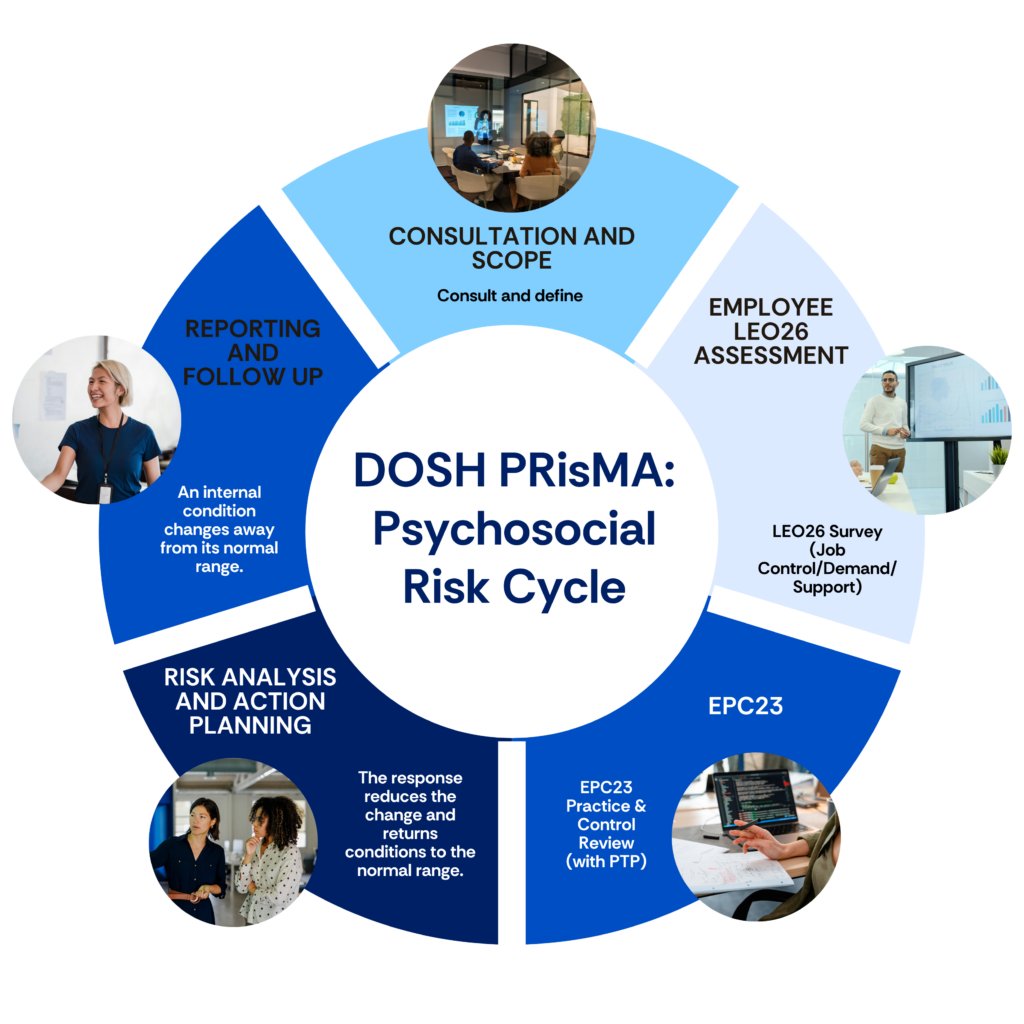
We begin by understanding your workplace concerns, organisational structure and assessment needs. The review can cover the entire organisation or selected departments.
Employees complete LEO26, which measures job control, work demand and job support to identify areas of higher psychosocial risk.
If LEO26 identifies a high-risk work unit, EPC23 is used to assess existing workplace practices and controls, with support from a Psychosocial Trained Person (PTP).
Findings are reviewed to identify priority areas and recommend practical improvements across workload, job design, support, communication and workplace practices.
Lyra presents the findings, recommendations and action priorities, followed by reassessment where needed. DOSH Psychosocial risk assessment treats the process as an ongoing cycle rather than a one-time survey.
Why Work With Lyra Health Malaysia

Lyra combines structured psychosocial hazards risk assessment with broader workplace mental health support, helping organisations move from assessment to practical action. Our PRisMA service can include:
- Stakeholder consultation and assessment scoping
- Employee briefing and LEO26 assessment
- EPC23 review for high-risk findings
- Analysis by a Psychosocial Trained Person (PTP)
- Organisation or department-level risk mapping
- Prioritised recommendations and formal reporting
- Leadership presentation and follow-up consultation
- Mental wellbeing awareness and employee support
The PRisMA psychosocial risk assessment tool is designed to do more than produce a score. Lyra helps organisations understand workplace risks, identify priority areas and take practical steps to improve employee wellbeing.
Frequently Asked Questions
Is PRisMA compulsory for every employer?
Employers are required under Malaysia's OSHA framework to assess and manage workplace safety and health risks, including psychosocial risks where relevant.
PRisMA is a recommended framework for DOSH-compliant psychosocial risk assessment, but the PRisMA tool itself is not the only permitted method. Other recognised assessment frameworks may be used where accepted by DOSH.
Is a PRisMA assessment the same as an employee mental health assessment?
No. A psychosocial hazards risk assessment examines conditions in the workplace, such as:
- Job demands
- Job control
- Management support
- Work organisation
- Workplace relationships
Individual mental health assessments or screening tools such as PHQ-9, GAD-7 or DASS-21 focus on aspects of an individual person's mental health. They serve different purposes. PRisMA is intended to assess workplace psychosocial conditions rather than diagnose an individual employee.
We already have an EAP. Do we still need a psychosocial risk assessment?
An EAP supports employees who need personal or psychological assistance. However, it does not, by itself, assess whether workplace conditions create psychosocial risk.
For example, counselling can help an employee manage stress, but it does not necessarily address:
- Excessive workloads
- Unrealistic deadlines
- Poor management behaviour
- Low job control
- Role ambiguity
- Workplace bullying
The PRisMA psychosocial risk assessment tool is needed for examining these work-related factors and the organisational controls currently in place.
Will HR see individual employee responses?
The assessment is managed with appropriate confidentiality and personal data safeguards.
Reporting should focus on workplace risks and aggregated findings needed for organisational action rather than unnecessarily identifying individual employees.
At Lyra Health Malaysia, we confirm the exact data collection, access, reporting and confidentiality process with each organisation before the assessment begins.
How often should the assessment be repeated?
Reassessment may be needed depending on the organisation's risk results, the effectiveness of implemented controls and changing workplace conditions.
A psychosocial hazards risk assessment should also be reconsidered when events such as the following occur:
- Major organisational restructuring
- Significant changes in working arrangements
- Increased complaints
- Rising turnover or absenteeism
- Critical incidents
- Emerging employee concerns
The objective is to determine whether controls are working and whether the organisation's psychosocial risk profile has changed.
Does completing PRisMA guarantee OSHA compliance?
No single assessment can guarantee an organisation's overall legal compliance. A DOSH psychosocial risk assessment can support an employer's wider occupational safety and health responsibilities by providing a structured way to:
- Identify workplace risks
- Document findings
- Review existing controls
- Implement appropriate measures
- Reassess effectiveness
The employer remains responsible for meeting its legal duties and implementing appropriate workplace controls.
Take A Proactive Approach To Psychosocial Risk
Turn insights into action with Lyra Health Malaysia. We help organisations identify workplace risks, prioritise actions and strengthen employee wellbeing through the PRisMA psychosocial risk assessment tool.